Friday, March 28, 2014

The first blossoms

I looked out the window on this cloudy, grey, drizzling morning and saw that the first blossoms have opened on our Shiro plum tree:


It really is spring!

Wednesday, March 26, 2014

What have I gotten myself into?

As I mentioned last week, my guild has issued a UFO challenge, and I signed up to complete the following three quilts, in no particular order:

1) my katazome "stone wall" quilt, started at a quilting retreat in back in fall 2012, shown here on my design wall from a slightly cockeyed angle:


2) the "Echino spring" wall quilt that's been boxed away for about a year now:


3) and finally, the flannel quilt that I worked on in early February, until I got sidetracked by little projects for my Etsy shop, followed by yet another cold:


I thought that seemed like a realistic set of goals, until I checked my photos of finished quilts since 2010 and realized that I only make 2-3 quilts a year!  I've already finished a little wall quilt this year, and I'm currently working on yet another wall quilt, but I still imagined finishing three other quilts?  What in the world was I thinking??!!

In addition, once I filled out my list of UFOs for the guild challenge, I immediately thought of all the other quilts I want to finish as well, including several quilts that I haven't even started yet.  Those projects include the following:

1) a second katazome improv quilt pieced in Dec. 2013;

2) a queen-sized batik quilt pieced two years ago (sans border);

3) a Michael Miller challenge quilt--not started, but I will make this quilt someday, even though the deadline is long past, because I have a really great idea for it!

4) a quilt mixing Kaffe Fassett stripes and solid shot cottons: not started, but something else I really want to make, because in my mind's eye it seems really promising;

and 5) an improv-pieced quilt centered on Japanese fabrics purchased in Aug. 2012, during the tri-guild meet-up in Seattle.

In addition, I could have listed a couple of much older projects: an improv-pieced quilt with beautiful autumnal colors that I started hand-quilting in 2003, and a small colorwash quilt that I pieced (again sans border) sometime in the late 1990s.  

This list does not include putting the final touches on last summer's studio makeover, plans for serious explorations of indigo dyeing this summer, and more sewing for my Etsy shop.   

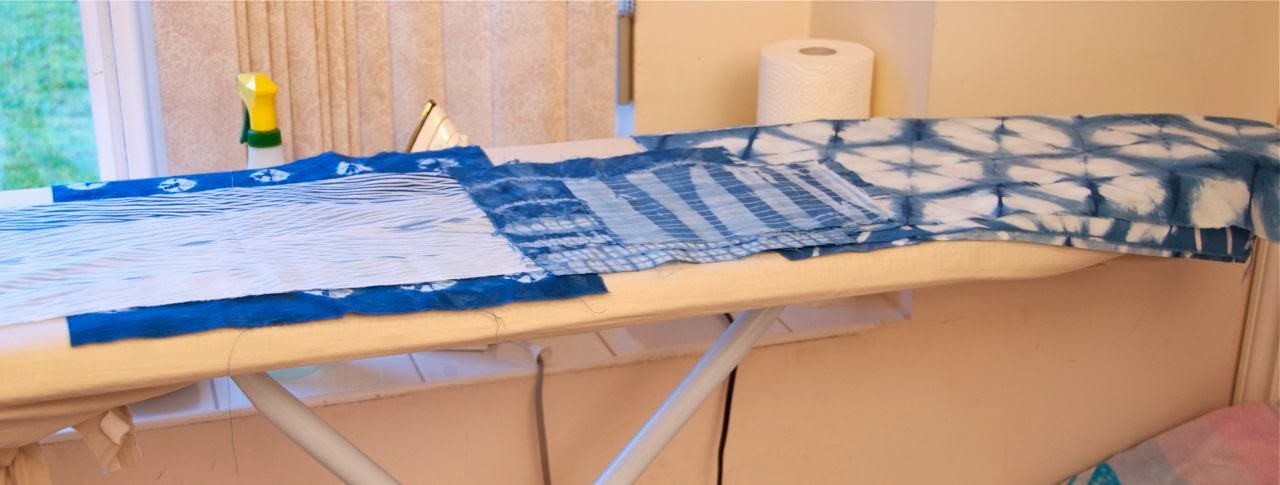
In short, I'll be lucky if I complete just two of the three UFOs on my guild list.  Oh, well.  Anyway, here's a glimpse at what's been in progress this week:


As you can see, I'm still playing with my indigo shibori fabrics.  I want the overall idea for the quilt to be a surprise, so I'm saving the full view of the quilt for the reveal when it's finished.  Fingers crossed for the end result within the next couple of weeks or so.

I'm linking up to WIP Wednesday on Freshly Pieced and at the Needle and Thread Network.  Cheers!

Tuesday, March 18, 2014

Finished! Shibori study #1

Last week's quilt is done: my first finish for 2014!


I might end up redoing part of the binding on the left-hand side, since some of the hand-stitched ending up peeking through to the front.  I think some of those stitches are visible in this close-up:


Yes, I know those stitches aren't that easy to see, but I'm picky.

Here are a few other close-ups, which show off the hand-quilting:


It was so satisfying to make this quilt--I love its graphic simplicity, and the speed with which it came together.  At the fall workshop, we used a lightweight organic cotton for most of our dyeing, and although I prefer working with heavier, more durable fabric, the lightweight cotton made the hand-quilting a breeze.  I still have a fair amount of leftover shibori, and I've already cut into it for another quilt. 

In other quilting news, my guild is running a UFO challenge this year.  I signed up with intentions to finish three quilts in progress: the Echino wall quilt that I started a year ago, the katazome improv quilt that I worked on at a retreat about a year-and-a-half ago, and the fun flannel quilt that I stalled on recently in favor of the shibori quilt.  But I don't think I'll get to any of these until I do the next shibori quilt.  Once I joined the challenge, I also immediately thought of another three quilts that could use finishing--two of which I haven't even started yet!  But hey, I have until October, right?

Tuesday, March 11, 2014

On the design wall: Shibori quilt

Remember the shibori indigo dyeing class that I took in the fall?  I've had more time for sewing lately, but I'm still in that mood of starting new projects rather than finishing the growing pile of partially pieced quilt tops.  Last Friday, those hand-dyed shibori cottons were calling to me, and I decided to make a quick wall quilt, something that I would actually have the wherewithal to finish immediately.  Here are the scenes from the work in progress over the weekend:

On the design wall:

The pieced top:

The remaining fabrics after cutting:


The top was small, so I decided on hand-quilting:


Hand-quilting in progress:


Since taking these photographs, I've finished the hand-quilting and cut off the extra backing fabric and batting around the edges.  All I have to do now is add the binding, and I will have my first finished quilt of 2014!


Friday, February 21, 2014

I'm still here, really...

The last few months have been a bit tough, thanks to a crazy time at the day job that had me working seven days a week for most of four months, plus a cold in December and the flu in January.  Not surprisingly, I didn't have much time for sewing!  But I'm still here, and things are a bit calmer at the day job now, so I've been sewing again.  For the past few days, I've been tending to my long-neglected Etsy shop by making a passel of passport covers:


I actually did manage some quilt-piecing over the past few months, although I've had a bad habit lately of starting quilt tops but not finishing anything.  I'm not sure why, but lately I've been in the mood for novelty, rather than sticking to projects and completing them.  Sooner or later I'll get back to following things up from start to finish, but for now I will just go with the flow.

Here's a partially pieced top that I worked on in December:


I had a beautiful set of vintage katazome scraps that were calling to me, and I couldn't resist working with them for a few nights.  I've finished the lower right corner since taking the above photograph, but I have yet to add the borders to this particular quilt top.

I started another quilt a few weeks ago: The Cloth Shop, on Granville Island, had a beautiful array of hand-dyed flannels on sale, and I couldn't resist buying some to reward myself for all my hard work lately.  Ah, shopping therapy!  No pictures yet, but I've pieced about half the blocks that I need.

Here's another set of fabrics on my mind--shot cottons by Kaffe Fassett:


I have a plan for these, honest!  I don't know when I'll get to them, though--I really want to finish piecing the flannel quilt first.  


Tuesday, November 12, 2013

Indigo dyeing workshop, part III: Pole wrapping

I am still savoring the memories from last month's shibori dyeing workshop.  On the second day, we learned a couple of different pole-wrapping techniques.  Here's Akemi's bokashi demo, in which she added a couple of pleats to take up extra fabric width, and then scrunched the fabric up on a piece of PVC pipe, with a twist for added interest:


I was a little afraid of pole-wrapping, since a friend of mine tried it once and found it difficult to wrap the fabric tightly enough.  But I tried two different techniques and loved, loved, loved the results.  Here's a peek at my arashi sample, dyed onto a lightweight organic cotton:


Can you guess how I prepared the fabric?  I pleated it back and forth lengthwise, wrapped it around the pole at an angle, tied it with some linen twine for the resist, and then scrunched it up onto the PVC pipe before sticking it into the dye bath.  As you can see from the photograph, the part that was on the outside took up the most color, while the innermost layer just took up a little bit of the indigo.

Everyone at the workshop had a blank habotai silk scarf, and I decided to use bokashi shibori to dye mine.  I didn't want big, solid borders, so I followed Akemi's example and put in a couple of lengthwise pleats before basting the scarf into a tube and scrunching it up onto the pole.  The basic process was simple, and I absolutely love the result:


I'm already dreaming about the quilts I can make after I dye some more cotton shibori fabrics in indigo.

Tuesday, November 5, 2013

Indigo dyeing workshop, part II: The dye bath


As I wrote in my last posting, over Thanksgiving weekend, I had the chance to take a wonderful shibori indigo dyeing workshop with Akemi Nakano Cohn, and in this entry, I thought I'd say more about working with the dye bath. 

I had never done any serious fabric dyeing before, and on the first day, the dye bath seemed very alien and forbidding.  When Akemi showed us how to make the dye stock solution and dye bath, I wrote down instructions in minute detail--how to make a paste with the indigo powder, how to transfer it to a Mason jar with a rubber spatula, how to mix in the lye solution, and then the thiourea solution, how to stir up the stock solution, and so forth.  There were a lot of prohibitions to keep track of: don't ever add water to lye (always the reverse, or you will regret the energy release from the chemical reaction as the water hits the lye all at once), don't mix too vigorously, or you will oxidate your stock solution and dye bath, don't wring out your fabric over the dye bath (do it under the surface of the bath), don't let the dye bath get too cold, don't splash or make lots of turbulence in the dye bath--basically, don't do anything that will add oxygen.  Also, don't forget to thoroughly wet your fabric before dyeing it.

On the one hand, there was something comfortably familiar with the setting, since I was a chemistry major once upon a time and logged plenty of hours in lab.  From that standpoint, there was nothing new about the necessity of keeping a particular solution in a reduced state.  But I also hadn't been at a lab bench in over 25 years!

By the second day, however, I felt like an old pro.  Granted, I didn't make the dye bath myself, but when I arrived, it had a beautiful yellow-green sheen, and I could tell immediately that we had particularly good bath to work with.  At a certain point in the afternoon, I could also see that the dye bath was pretty much exhausted, and I helped to stir (not too vigorously!) after Akemi added more dye stock (don't forget to wait 30 min. or so before the revived bath is ready!).

Here are two of my favorite pieces from the second day:


Both are dyed Kona PFD.  For the workshop, we were supplied with a lighter weight organic cotton, but I also bought some Kona, since it's the weight I prefer for quilts, and I wanted to see how it would do in the indigo bath.  It dyed beautifully, and I was really pleased.

The first piece is nui (stitched) shibori.  After the first day of the workshop (and after Thanksgiving dinner), I did eighteen rows of hand-stitching.  It took about two hours altogether, plus another fifteen minutes to pull all of the stitches tight.  I dipped it four times in the dye bath (dipping means putting something in for about 15 minutes, and then taking it out for 20 minutes or so to oxygenate before putting it in the bath again for another dip).  Had there been time, I would have put it in the bath for another two rounds, but even so, I'm pleased with the depth of color.

The second piece is itajime shibori, which involves folding and clamping.  I just pleated the fabric lengthwise, and then pleated the resulting long strip again, down to the right size to clamp between two rectangular pieces of wood.  The wood acts as a resist, which leaves most of the piece with just the barest tint of blue, in between the dark areas that are at the edges of the clamped fabric.  Again, I dipped four times, which made for a strong and beautiful contrast.

Maybe it's hubris, but I do feel confident about continuing my indigo dyeing experiments on my own, and I am already imagining a dye shop in the backyard this summer.